For decades, a body of research rooted mostly in Western environmental psychology has encouraged people to strengthen their relationship with nature. You might hear:
“Bathe in the forests”.
“Tune into the sights and smells, noticing birdsong, caressing bark and moss”.
“Spend reflective moments beside water”.
Indeed, I regularly encourage people to do these things. Such experiences are valuable, and a substantial body of research links feeling connected to nature with greater wellbeing and stronger support for environmental protection.
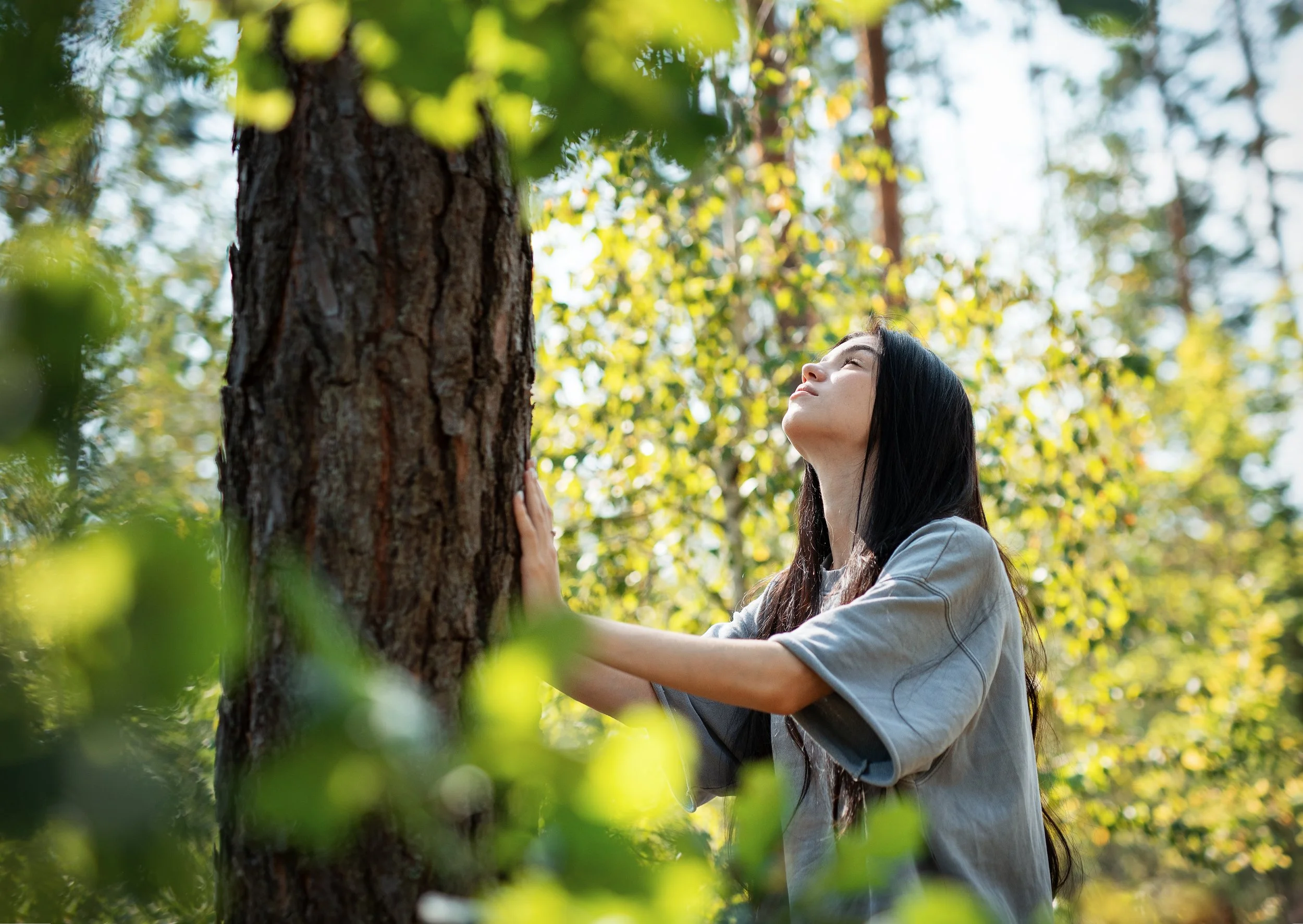
But hidden inside the language of ‘reconnection’ – even when we explicitly acknowledge that “humans are nature” – is a conceptual tension. To reconnect with something implies that two things have become separated. There is the person, and there is nature to which that person might return.
Some of that loss of contact is real.
For example, modern urban life measurably narrows our contact with naturally diverse environmental microbes (like the bacteria, fungi, viruses in soils and the air) and the wider community of species humans evolved alongside – a change with real consequences, including for immune development.
But much of the deeper sense of separation – the feeling that the self is a bounded thing set apart from nature – is perceptual and cultural rather than an ecological reality. Reduced contact or engagement is not the same as ecological independence. Humans never ceased to be embedded within, dependent on and constituted through living systems, even as the range of those relationships has thinned for many people.
An interesting question, then, is whether our biological understanding of the ‘self’ has fully caught up. A complication is that the human body is itself a ‘walking ecosystem’ nested within, and continually exchanging with the larger ecosystem it inhabits. Indeed, the person looking at the forest is not one organism in any simple sense, but a shifting community of ‘human’ cells, plus bacteria, fungi, archaea and viruses (and we have 380 trillion of them inside us at any given moment).
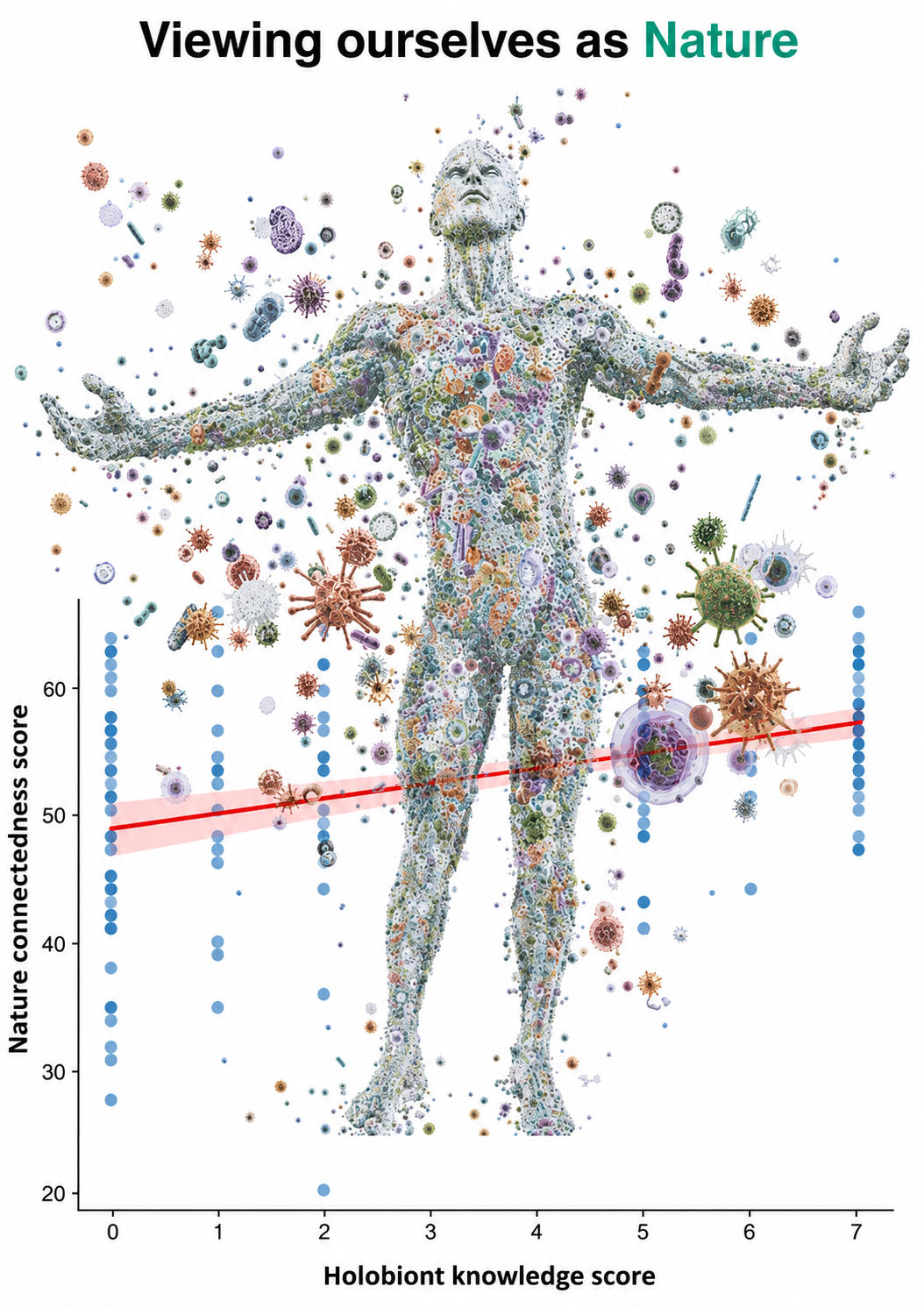
Our recent study, ‘Viewing ourselves as nature: Holobiont literacy influences nature connectedness’, published in Ambio, suggests this change in self-perception could be important for our psychological relationship with the rest of nature.
Using a randomised control design, we measured how connected people feel to nature (their ‘nature connectedness’) using validated psychometric instruments. We also measured their knowledge of the holobiont concept – the fancy way of saying that we’re hosts living in close association with diverse microbial communities residing in/on our bodies.
Participants who already knew more about the holobiont concept reported stronger nature connectedness. But why might this be? It could be because people who feel more strongly connected to nature are more inclined to seek out information on the holobiont. But more strikingly, simply exposing participants to information about humans as holobionts increased how connected to the rest of nature they felt. The finding points to a possibility that reaches beyond but is aided by advances in microbiology: nature connectedness may depend partly on where we imagine the self ends (if it ever does).
What a holobiont is – and isn't
A holobiont is a host organism together with its associated microbial communities. In a human, trillions of microorganisms live on the skin, in the mouth, throughout the gut and across the body’s other microhabitats. Does this mean that humans and their microbes form one perfectly harmonious superorganism? I think that’s an unrealistic claim, and the concept’s scientific boundaries are genuinely debated. Microbial relationships are variable and dynamic – cooperative, neutral, competitive or harmful depending on context. Not every microbe is a permanent resident, and the host and microbiome shouldn’t automatically be treated as a single unit of evolution.
But what the concept does capture is that human biology (and behaviour) doesn’t arise from ‘human’ genes alone. Our development, digestion, immune regulation and metabolism – and, early preclinical evidence suggests, potentially aspects of cognition and mood – are shaped by relationships with these tiny creatures. The body is less an isolated machine than a living habitat – selective but permeable, recognisable but continually changing. And evidence is growing that caring for our microbial inhabitants is a good way to look after ourselves – as John Cryan says, “you are what your microbes eat”.
From reconnection to constitution
Much of the nature connection science and practice directs attention outward – look at the trees, listen to the birds, notice the light on the water. Holobiont literacy asks us to look in another direction – toward the ecological relationships operating beneath and within the porous boundary of the body.
That directional shift changes the underlying narrative. As mentioned, one common way of narrating the story is that humans have become separated from nature and must reconnect with it. The holobiont account begins somewhere else entirely. Humans were never biologically separate in the first place – as Haahtela (2019) said, “we are protected by two nested layers of biodiversity”, even if we damage the outer layer and build literal walls between us and it.
We may feel disconnected, and our modern cities and economies may be organised around fantasies of ecological independence – but materially and metabolically, disconnection was never an available condition. One could argue then, that part of the crisis is a failure to perceive relationships that were present all along.
I often ponder the difference between connection and constitution. Connection describes a relationship between two separate entities – a person can feel connected to a river while remaining conceptually distinct from it. Constitution goes further as it suggests relationships help make an entity what it is. The food we eat becomes tissue. Molecules produced by microbes interact with our own bodily systems. The environments we inhabit leave biological traces within us. Even the places we conventionally treat as bodily edges are ecologically busy ones. Skin is habitat. Within the gut walls lie one of the densest microbial communities associated with the human body.
None of this means the individual simply disappears, or that personal identity reduces to a microbial census. But even the idea of a stable, bounded ‘self’ is philosophically and scientifically contested. Some traditions and thinkers treat the self as a useful construction, an emergent process or even an illusion rather than a fixed entity. I’m certainly not going to resolve that debate here. The narrower point is that, whatever the self ultimately is, its biological boundaries are far less clean and self-contained than everyday intuition suggests. An individual produced and sustained through relationships is a different kind of individual from the sealed, sovereign self that some ‘reconnection’ language may reinforce.
Technology can estrange – but it can also reveal
Technology is often cast as the enemy of nature connection, and there’s good reasons for that. After all, screens capture attention that might otherwise go to the living world, and urban infrastructure conceals the ecological processes sustaining daily life. But the relationship between technology and perception isn’t only one of narrowing.
Telescopes revealed that Earth was not the centre of the cosmos. Microscopes exposed invisible worlds inside drops of water, and microphones helpmake audible the hidden lives of many elusive animals – from bats to earthworms – as our soil ecoacoustics work is revealing. Environmental DNA reveals the traces organisms leave in water, air, plants and soils. Indeed, DNA sequencing technologies have now extended that same expansion of perception in an especially intimate direction – revealing ecological complexity not only around us, but within us.
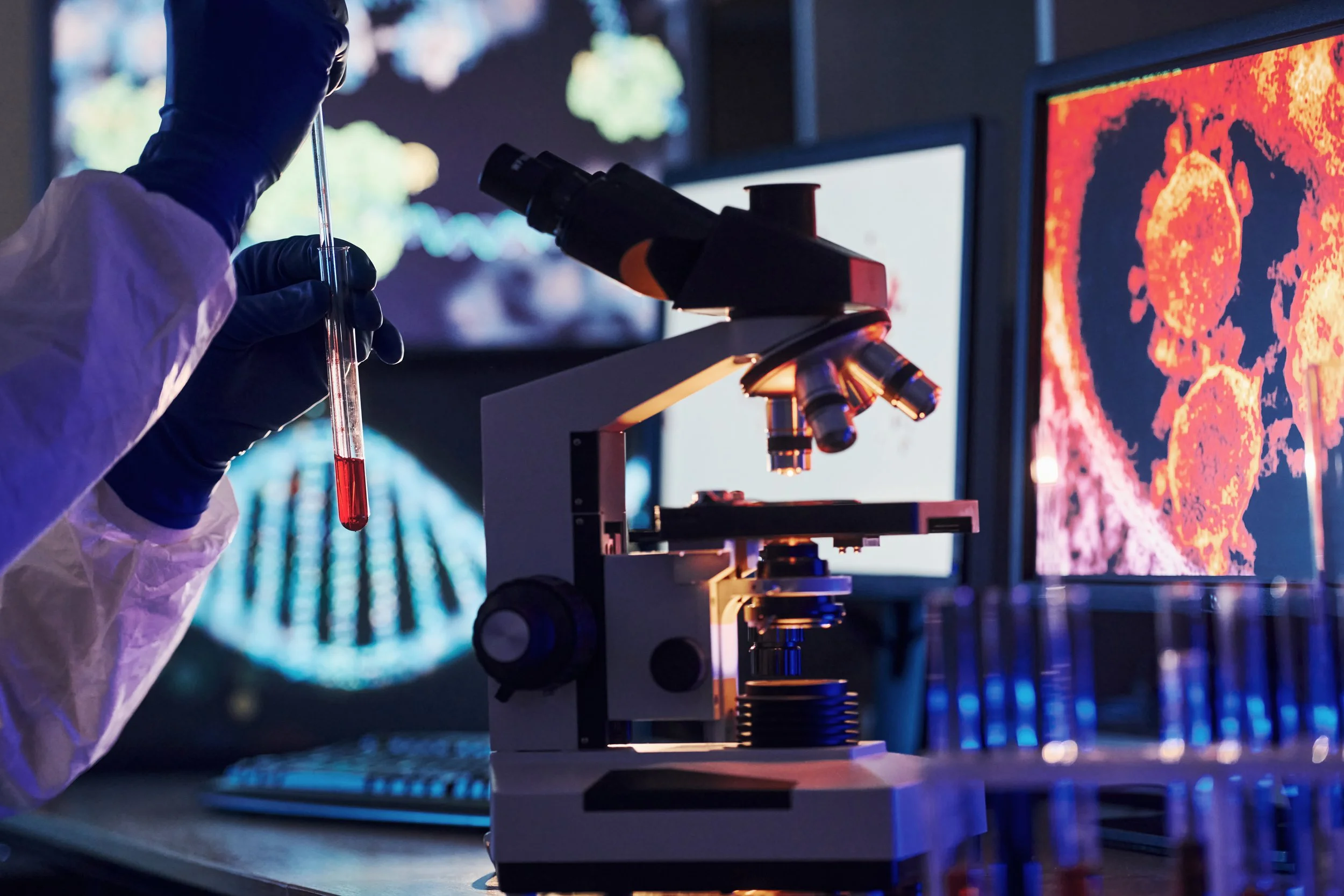
This is an unusual kind of perceptual revolution. The telescope transformed our understanding of where we are. Microbiome science is transforming our understanding of what or who we are. Our biological relationships, especially the symbioses between the visible and invisible realms, haven’t suddenly appeared – our capacity to perceive them has changed. That capacity is what we might call an expanded ‘Umwelt’ or the perceptual world available to an organism, stretched by instruments into territory our unaided senses could never previously reach.
A few years ago, Ross Cameron and I described a related problem as the ‘Holobiont Blindspot’: our tendency to interpret human traits, behaviours and cognition as properties of the individual alone, while overlooking the possible influence of the microorganisms associated with that individual. Characteristics we casually attribute to ‘personality’, temperament, preference or even decision-making may, in some cases, be partly shaped by host–microbiome interactions. The blindspot, then, is not simply that microbes are invisible to us – it’s that their potential contribution can remain invisible in the explanations we construct about who we are and why we behave as we do.
But as our Umwelts artificially expand, perhaps these blindspots will begin to dissolve.
Indigenous concepts
It would be wrong to suggest that modern microbiome science has ‘discovered’, for the first time, that human life is relational. This calls for cultural care. Diverse Indigenous knowledge systems have long understood people through relationships with Country, kin, ancestors, plants, animals, waters, seasons and other-than-human life – not as a metaphor, but as law, responsibility and lived practice. For example, the Kombumerri scholar Mary Graham, with ties to the Wakka Wakka nation through her mother’s people, has written of an Aboriginal worldview grounded in relatedness, in which land is a primary, sacred, animate reference point that people belong to rather than own. Moreover, the Bawaka Collective in North East Arnhem Land lists ‘Country’ itself as a co-author on its published work, treating land as an agentic knowledge-holder rather than an object to be studied.
I also want to be careful to say that these are specific, citable bodies of thought, not a generic backdrop – and they shouldn’t be flattened into one. Nor should microbiome science be presented as finally proving Indigenous knowledge correct – as though modern scientific verification were required to confer legitimacy on knowledge systems that never needed it. Indigenous relationality and microbiome science emerge from different histories, practices, responsibilities and ways of knowing, and thus, are not interchangeable. But what microbiology does offer is a different, technologically mediated path toward something adjacent to what these relational knowledge systems have long held. Many societies possessed sophisticated empirical knowledge of fermentation, decomposition, soil fertility and healing, and understood that human life depended on more-than-human relationships and responsibilities – without needing to visualise a bacterial cell or sequence a genome.
The novelty in microbiome science, then, isn’t the discovery that humans are relational. It’s one particular, albeit rather profound, window onto relationality, reached through a different set of tools, concepts and evidentiary traditions. In some places it may resonate strongly with relational understandings articulated elsewhere; in others, it may open distinct questions. Either way, it adds another route for unsettling the myth of the isolated human.
An open research landscape
Our Ambio study offers an early indication that holobiont literacy can influence nature connectedness. In my mind, several questions now bubble to the surface:
- Does holobiont literacy reliably produce humility and ecological concern, or could it also provoke anxiety or disgust in some people? This matters in a cultural context where germaphobic narratives have often trained us to interpret microbial presence primarily through contamination, danger and removal.
- Do personalised microbiome visualisations – images, sonification, immersive and perhaps technology-mediated experiences – produce stronger effects than general information?
- How does the concept interact with the diverse Indigenous and non-Western relational understandings of personhood specifically – rather than treated as one undifferentiated comparison group?
- And, perhaps most importantly, does seeing the self as ecologically constituted lead to greater care for the rest of the living world, or does it remain an intriguing idea with no practical consequence?
These questions push nature connectedness research further into how scientific concepts, Umwelt-expanding technologies, and relational ways of knowing that many communities have long held can each reshape environmental identity. Sometimes the more transformative intervention may not be persuading people to care about something ‘out there’ – it may be redrawing and perforating the perceived boundary of the person doing the caring.
From microbial awareness to microbial responsibility
There's a risk in moving too quickly from scientific description to moral prescription. The fact that humans depend on microbial communities doesn’t by itself tell us how we should act. But perception shapes what becomes morally visible.
Forests are easier to treat as inert resources when their ecological (and social) complexity are ignored; animals are easier to regard as machines when their cognition is denied. Microbial communities may likewise stay ethically invisible while they’re perceived only as anonymous germs or biochemical background. The International Microbiology Literacy Initiative (IMiLI) led by Ken Timmis aims to help shift that perception by making microbial life more legible, not simply as something to fear, eliminate or exploit, but as an integral part of the living systems that sustain us (see my book, Invisible Friends for more on this perspective shift).
Greater microbial literacy could broaden that field of concern – prompting questions about how urban design, land management, food production and antimicrobial use alter the microbial systems that human and non-human life depend on. This doesn’t require treating every bacterium as an individual moral patient; microbial life operates at scales that arguably resist that framework. But it can support a form of microbial stewardship or care for the ecological conditions that sustain diverse, functional relationships among microorganisms, hosts and environments.
Seeing ourselves as holobionts doesn’t mean every microbe is beneficial, or that exposure is always desirable. It means health can’t be understood entirely through a war-against-microbes framing, and that the language of purity and eradication becomes harder to sustain once microbial relationship is recognised as a normal part of human existence. And this brings us back to nature connectedness. If part of feeling connected to nature depends on how we imagine the self, then microbial literacy may influence not only what we know about microbes, but the very boundary across which ‘connection’ is felt.
Learning to see ourselves differently
For much of modern environmentalism, the task has been to make nature visible – to show people the beauty of threatened species, the complexity of ecosystems, the scale of loss, and so on. That work remains vital. But microbiome science presents a different challenge, as it asks us to make visible the unseen nature through, across and beyond humans and other creatures.
This is a grounded recognition that our lives are assembled and maintained through relationships with other forms of life – relationships our senses didn’t evolve to perceive directly, and that scientific instruments now offer a partial, still-developing view of. What we do with that view remains an open question.
We could, as some do, absorb microbiome science into the existing culture of self-optimisation, turning microbial communities into another personal asset to measure and control. Or we could let it unsettle the story of the sealed, sovereign individual – and use it to enrich a conversation already underway across biology, psychology, philosophy and diverse cultural traditions about what a person actually is.
And perhaps the task isn’t only to help people feel more connected to the rest of ‘nature’. It is also to help people recognise that, whatever the ‘self’ ultimately is, our biological existence is already holobiotic – constituted and continually shaped through relationships with other life.
See our paper Viewing ourselves as Nature: https://pubmed.ncbi.nlm.nih.gov/42089950/